Showing posts with label 2nd Test. Show all posts

Friday, February 19, 2010

India win thriller despite heroic Amla


India 643 for 6 dec (Sehwag 165, Laxman 143*, Dhoni 132*, Tendulkar 106) beat South Africa 296 (Amla 114, Petersen 100, Zaheer 4-90, Harbhajan 3-64) and 289 (Amla 127*, Harbhajan 5-59, Mishra 3-78) by an innings and 58 runs.

Scorecard

They couldn't out Hashim Amla at all. So India, down to three bowlers and led by an exceptional Harbhajan Singh, found a way around him, leaving him stranded with nine mandatory balls to go and sealing a heart-stopping, series-levelling win that also meant they retained the top spot in the ICC rankings. As was fitting, it was Harbhajan who brought about the final wicket with a slider to the left-hand batsman Morne Morkel, who had put together a 76-minute last-wicket stand with Amla. The final few steps didn't come easy for India: the last three wickets batted out 53.3 overs to set up a beautiful Test-match finish.

For eight hours and 19 minutes in this innings, which took to 23 hours and 22 minutes the total time he's spent at the wicket for the series, Amla saw everything: offbreaks, topspinners, unintended doosras, big legbreaks, googlies, bouncers, full ones, a blow to the elbow, the bowlers' joy, their frustration, and Harbhajan's eruption on taking the last wicket. At every stage - when he reached fifty or his hundred, when he was hurt, when he was concentrating, when he was defending, during those final few overs of counting each delivery down, and when he was walking back after one of the biggest disappointments he has experienced on a cricket field - the calm expression on his face was unchanged.

Amla batted like the Monk who didn't need to sell a Ferrari, and it took a special bowling effort to deny his side the series win. Harbhajan answered India's call with spin bowling aggressive and patient, smart and persistent, and came up with that wicket-taking delivery when it had deserted the other bowlers.

If Amla never looked like getting out, Harbhajan never looked like letting anyone settle. India had 98 overs to get seven wickets but 52.2 of them were a write-off: they were bowled to Amla, and this man was not going to get out. Not today. They did well, though, to create enough pressure in the remaining overs - despite two dropped catches - to finish off the match with 16 minutes remaining in the day's play.

India woke up to a bright and sunny day, but were thwarted in the first session by Amla and Ashwell Prince. For about two hours, Amla kept killing their hopes, Prince kept raising them only to not edge to hand. Finally, just when the draw started to become the favoured result, Harbhajan came back for his second spell of the day, from his favoured High Court End.

In the first spell, he had tried to get Prince lbw in a fashion similar to the one in the first innings, and failed. In his second he went over the stumps and made it difficult for Prince to judge which deliveries to leave. The leg line troubled Prince, and finally he jabbed at one outside off and lobbed it to mid-off.

Amit Mishra once again produced the special delivery out of nowhere, this time a googly to take out AB de Villiers in the penultimate over before the lunch break, the third time he had taken a wicket just before a break in the innings. de Villiers' was the big wicket because he was the one batsman capable of using his feet and hitting spinners off their length.


Hashim Amla stood between India and victory, India v South Africa, 2nd Test, Kolkata, 5th day, February 18, 2010


In the second spell, six overs each either side of lunch, Harbhajan looked menacing with almost every delivery. After lunch, Harbhajan went on to suggest JP Duminy might become his new Ponting. Offbreak, offbreak, slider. Duminy caught in front again. Dale Steyn didn't have a clue about deliveries spinning down the leg side, and kept getting beaten. Harbhajan smartly moved round the stumps, and trapped him too.

Thereafter Amla found an able partner in Parnell, who looked much more assured than Steyn, and helped by a dropped catch by Suresh Raina at a wide fourth slip, played out 24.2 overs. Amla manipulated the strike well: out of eight overs that Harbhajan bowled during that stand, Parnell got away by facing only 12 balls from the best bowler around.

A soft shot befitting a No. 9 arrived duly, after which Amla shielded Paul Harris for a while. From facing four balls of each over, he gradually let Harris face three each, and by the time Harris generated enough confidence in Amla, a soft shot befitting a No. 10 came by. Ishant got both the wickets, but 8.3 more overs had been negated.

That started the most exciting period of the match. Morkel batted solidly along with Amla, they both judged the leaves well, they both defended with soft hands, they both frustrated India more with every passing delivery. Towards the end, mind games began. Amla took a single late in a Mishra over to face Harbhajan in the next over, Dhoni removed Harbhajan and tried the part-time stuff from Sachin Tendulkar and Sehwag, and got Harbhajan to bowl at Morkel again.

Nothing gave. Amla seemed to have found a partner who was holding his nerve well. The desperation on Indian faces kept getting more and more apparent with every passing delivery. With 3.2 overs to go, Amla cut Tendulkar towards the boundary, took a single so as to face two more overs as opposed to one. Sehwag hoped it would reach the boundary as he chased, but slyly tried to kick it over when he saw it stop inches before the rope. Just to keep Morkel on strike. That's how much it mattered.

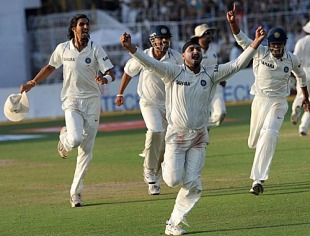
Amla duly played out the next over, Dhoni duly saved Harbhajan for the over after that. Harbhajan had six more balls left, from the High Court End. The first pitched middle, turned away. The second pitched leg, and broke towards off. The third was the killer slider, Morkel made his first mistake in 60 deliveries. Harbhajan roared, Amla's expression didn't change much.

Thursday, February 18, 2010

India ahead on stop-start day


South Africa 296 and 115 for 3 (Amla 49*, Mishra 2-15) trail India 643 for 6 dec by 232 runs.

Scorecard

Amit Mishra, who had struggled to buy a wicket until the penultimate day of the series, provided two inspirational moments just before two session breaks to keep alive India's hopes of a win on a day that they could managed only 157 minutes of play. Hashim Amla, who had scored 367 runs in two innings before this, was made to dig deep into his patience and skill reserves, and will be hoping he has more in the tank. India would have been much more comfortably placed despite bad light and rain had M Vijay held on to a sharp chance from Amla at backward short leg.

On a riveting, if truncated, day's play India couldn't manage wickets in a hurry but got three of them at regular intervals. Graeme Smith came out bull-headed and, along with Alviro Petersen, almost batted out the one-hour first session. Five minutes before the break, though, Mishra got him with his first delivery. In the second session, Harbhajan Singh, looking menacing with almost every delivery, got Petersen early. Amla and Jacques Kallis looked pretty comfortable for 16 overs, but in deteriorating light Mishra got Kallis with a beauty minutes before the players walked off.

Zaheer Khan got an iffy moment each out of Smith and Petersen in the first few overs, but wasn't helped by the inexplicable choice of just two slips and a gully in his third over. Petersen survived then, but it was Harbhajan - opening the bowling - who looked the most difficult to negotiate.

Harbhajan tested both the batsmen with his drift and dip, and the bounce that the pitch has provided on each of the four days. Smith made sure he didn't repeat the mistake Ashwell Prince and JP Duminy committed in the first innings. His first instinct was to play at every delivery, but he watched the rotations closely, and only if certain of an offbreak he left it alone. Against Zaheer, Smith took a middle and off guard, covering the stumps better, preventing a repeat of the earlier two dismissals.

Against Mishra, though, it seemed Smith let the guard down, and paid for it. He played all around an accurate legbreak, missed, and was trapped in front. India went in to the break a confident side, and came out a confident side.

Just before the break, Harbhajan had got one to bounce and break at Petersen, but there was no backward short leg to take the catch. In his first over after lunch, he nearly got Amla who swept at a full delivery and somehow managed to get an inside edge. In his second, the inevitable Harbhajan dismissal arrived, with another ball turning in sharply to Petersen, and taking the bat and pad. It took a smart catch from forward short leg S Badrinath, though, who went up high to his right, parried it, and then recovered quickly to take the rebound.

Harbhajan was on a roll, and in his third over after the break, got an inside edge from Amla, but Vijay couldn't get down in time. It was the 20th over of the innings, and the Amla-Kallis partnership had hardly even begun. After that and before the eventual Kallis dismissal, neither of the batsmen struggled.

Ishant Sharma's bouncer ploy didn't work: Amla swayed away easily, Kallis pulled him. Harbhajan was swept regularly by Amla, and easily defended by Kallis. Zaheer looked off in his post-lunch spell and was taken off after one over. Mishra's four overs were easy to negotiate.

Then Mishra changed ends and started his third spell off with an accurate maiden to Amla. The second ball of the second over landed around middle, Kallis had to play at it and made provision for the spin as he did, but the ball turned more than budgeted, took a thin edge and settled in MS Dhoni's gloves. It was a big moment in an important day's play: two balls before the dismissal the umpires discussed the light situation, and four balls later walked off for bad light.

That was at 1.44pm, 41 minutes before scheduled tea. Rain followed soon and play resumed at 3.20pm, only for light to deteriorate within three minutes. During this period, Harbhajan bowled one over and Alma cut him for a four to move to 49.

Wednesday, February 17, 2010

Laxman and Dhoni flatten South Africa


South Africa 296 and 6 for 0 trail India 643 for 6 dec. (Laxman 143*, Dhoni 132*) by 341 runs.

Scorecard

VVS Laxman and MS Dhoni saw off the tricky period with the second new ball, put together the second double-century stand of the innings, and virtually batted South Africa out of the Test. It was only the second instance of four Indian batsmen scoring centuries in the same innings. It was also Laxman's fourth hundred in nine Tests at Eden Gardens, taking his tally at his beloved ground to 1041 runs at 94.63.

Staring at a massive deficit of 347, South Africa were left needing a huge batting effort, a turnaround of the proportions of the one at the same ground in 2000-01, to make something out of this match. They didn't help themselves by continuing to drop catches: Laxman added 95 after his reprieve, Dhoni 109 after his, and nightwatchman Amit Mishra 23. That to go with the 118 Virender Sehwag added after he was dropped on the second day. They were not all easy catches, but South Africa usually take eight out of 10 such chances.

The crucial period of play was just after Mishra had got out after an entertaining cameo full of edges, plays and misses, and also cracking shots. The lead had reached 88, but with the second new ball Dale Steyn had got his swing back. Morne Morkel was his usual aggressive self, and had Mishra's wicket in his bag. Laxman was caught in a shell, not struggling but he had let Mishra take the ascendancy. South Africa could sense a comeback and were giving it their best with their best bowlers bowling in tandem.

Laxman handled the fast bowlers well. He left outside off and didn't let the bouncer barrage or a period of no runs for 37 balls rattle him either. The closest South Africa came to getting a wicket was an inside edge that flew to the left of the keeper. Once Morkel went off - he had fever - runs came easily, the storm had been weathered, and it was time to accumulate.

Dhoni welcomed back Paul Harris, who could have had Mishra in the second over of the day but for the drop by Jacques Kallis at slip, with a four and a six in his first two overs. India's plan was clear then: Laxman was to be the solid anchorman, and the others were to score quickly around him. In the last over before lunch, Dhoni pushed forward at Harris, the ball spun and the edge flew to left of slip. Kallis had by then taken a special overhead catch to remove Mishra, but this one didn't stick - the third such instance off Harris' bowling in a session and one delivery. Dhoni was 23 then.

In the first over after lunch, Laxman cut Wayne Parnell for four to enter his 40s, and steered him past gully for another four in his next over. Off the next ball, a similar shot went uppishly towards JP Duminy at point. The ball fell slightly in front of him, but those are the catches the South Africans take without making them look tough.

After that Laxman and Dhoni, untested, unquestioned, sauntered towards their centuries. They took their own, unique routes. Laxman was unhurried, there were lovely inside-out drives, flicks out of the rough against Harris, and he used the fast bowlers' pace for scoring on the leg side. Dhoni presented a contrast, walking down the stumps to counter the swing, moving about in the crease, hustling through for ones and twos, relying more on power than timing.

After they reached their centuries, both batsmen naturally accelerated, again in their unique ways. Laxman started flicking more and playing more inside-out shots than before. Dhoni lofted Duminy for back-to-back massive sixes, hit Wayne Parnell through covers, and even turned down singles to Laxman. From 100 off 203 Laxman went to 143 off 260, Dhoni went from 100 off 159 to 132 off 187, and the two recorded the third-highest seventh-wicket partnership in Test cricket before the declaration.

Thirteen minutes after India declared, light deteriorated suddenly, reducing the possibility of 11 overs to five actual deliveries, which the South African openers survived.

Tuesday, February 16, 2010

Sehwag and Tendulkar drive India ahead


India 342 for 5 (Sehwag 165, Tendulkar 106) lead South Africa 296 (Amla 114, Petersen 100, Zaheer 4-90) by 46 runs.

Scorecard

The Sehwag storm struck South Africa with full force and pretty much blew everything in its way to a 13th 150-plus score. Amid the mayhem, it was easy to forget the cool, pleasant breeze that was Sachin Tendulkar's 92nd international century - his fourth in four Tests. They added 249 runs for the third wicket and kept South Africa wicketless for 57.4 overs but, once the two quietened, South Africa struck back with three quick wickets to retrieve some of the momentum in the match.

Sehwag rattled them with a vicious assault on the new ball, put behind him the Gautam Gambhir run-out and, after a brief quiet, punished them some more. His 87-ball hundred would have been even faster but for a relative lull of 10 off 21 balls. Tendulkar enjoyed playing in the shadow of Sehwag's strike-rate, kept scoring at an even pace and, unlike Sehwag, didn't give South Africa a single chance.

Two critical moments in the first session determined the flow of the game. Sehwag - 43 off 21 then - had the fastest Test fifty and a few other records in sight when he ran Gambhir out, and he chastised himself by playing disciplined cricket for a while. Around the same time Morne Morkel indulged in some reverse-rattling, took out M Vijay, troubled Sehwag with accurate bouncers and induced an edge only to see JP Duminy - at first slip because of the finger injury to Graeme Smith - drop him on 47. Sehwag could have gone at an even more frenetic rate but for the run-out. South Africa could have been in control had Sehwag fallen then.

Sehwag's onslaught started when Dale Steyn failed to get any swing. Somehow the ball didn't come out right, the seam wobbled, and Nagpur was a distant memory. When there is no swing, Steyn's pace is his biggest enemy so today the faster they came the faster they went. Nor did he get the Morkel's bounce, which meant that when Steyn went for the ribs, Sehwag could easily flick it past midwicket.

The storm started with that gentle little flick and then came three boundaries in three balls in the third over: placed over point, whipped to square leg, and slashed past point. Morkel got the treatment in his third over too: three boundaries through the off side, one off a delivery that clocked 152.6kmph. Wayne Parnell replaced Morkel immediately, and immediately he was carved for a four and a six into the rubble of a stand under reconstruction.

The next ball Sehwag faced he hit an off-drive for four, and then came the run-out. It was time for drinks and Sehwag threw away his protective gear in disgust. That was when Morkel came back but his charged-up, accurate burst seemed to have ended with that dropped chance.

When Sehwag came back from lunch, the cautious approach had been thrown out and he was blazing away again. For company he had Tendulkar. If you were a bowler, there was nowhere to hide.

Sehwag showed that to Steyn early in his second spell. Punch, whip, steer, 10 runs off three deliveries. Steyn to Sehwag then: 11 balls, 25 runs, five boundaries. Tendulkar joined the fun, defending everything full but steering Steyn for two boundaries. Paul Harris, meanwhile, didn't have the luxury of a big score, bowled round the stumps, and was slog-swept and hit inside out by Sehwag for a six and a four.

Back came Morkel, the best bowler on the day, to be given the worst sort of treatment a best bowler can be given. This time Tendulkar took the lead. Two fullish deliveries, two clips to the on side, one to the left of square leg, one to the right. In his next over, he gave Sehwag width with three deep fielders on the off side. One to the left of deep point, and one to the right. Sehwag 89 off 72, Tendulkar 38 off 61. India were 165 for 2 in 30.2 overs, with the bonus of South Africa's two best bowlers negated.

In between the hard-hitting there was some toying, with paddles from outside off, reverse-sweeps, clips past midwicket as Sehwag reached his hundred and Tendulkar his fifty without further incident. Harris eventually started bowling over the wicket, and was called wide 12 times because, unlike in Nagpur, he was not looking to get wickets here.

The runs slowed down post tea. When Sehwag was 128, AB de Villiers, the replacement keeper, missed an easy stumping. By the time Duminy made good his mistake, getting Sehwag in his first over, it might just have been too late. Not quite. Harris went round the wicket in the next over - inexplicably it took him until the Sehwag dismissal to do so - and got a false shot out of Tendulkar.

Steyn came back right away, got his swing back, and beat S Badrinath in the man-versus-boy contest. VVS Laxman struggled to fight the momentum and edged Harris in the next over. It flew wide of slip, the light deteriorated and India ended the day retaining the upper hand despite that late South African surge.

Monday, February 15, 2010

India recover after Amla and Petersen tons


South Africa 266 for 9 (Amla 114, Petersen 100, Harbhajan 3-60, Zaheer 3-77) v India .

Scorecard

They must have read about it. They must have heard about it. They must have planned for it. Graeme Smith, Jacques Kallis and Hashim Amla have played a Test there before. Nothing, though, can be preparation enough for an Indian comeback from the dead at Eden Gardens.

On Sunday, South Africa met the devil himself, and didn't know what to do. They had reached 218 for 1 in 58 overs, via assured and quick centuries from Amla and debutant Alviro Petersen, when the famous Eden Gardens turnaround began. Eight wickets fell for 43 runs, Harbhajan Singh took three in two overs, VVS Laxman ran from first slip to short fine leg to take a catch, the crowd seemingly intimidated the batsmen, two of the middle-order batsmen just froze, AB de Villiers ran himself out, Zaheer Khan hit with a pick-up-and-throw, and the batsmen forgot about scoring runs.

And, by the way, there were only about 35,000 present in the ground because half the stands have been brought down for renovation. And it was virtually a two-man attack, with Ishant Sharma and Amit Mishra looking innocuous for most of the day. And Amla and Petersen had all but beaten the hapless looking fielding unit into submission.

Parallels with The Test were inescapable. Australia had pummelled India in Mumbai back in 2000-01, much like South Africa did in Nagpur. Australia had reached 193 for 1 in Kolkata when the Harbhajan show began with the wicket of Matthew Hayden.

Today, though, it was Zaheer who started the magic. Ishant had just bowled a spell full of bouncers in the afternoon, hitting Amla - not out on 100-plus - on the arm guard once, but had overdone the short stuff. Zaheer, though, got the wickets, dismissing a centurion either side of tea. He did Petersen in with slight seam movement away from off, and then got a top edge from Amla. Two wickets for 11 runs, game on again.

Harbhajan, who had got drift and bounce, looked better than he did in Nagpur, and had Amla dropped when on 60, could now sense it. He tossed the ball up nicely, got dip and drift, Kallis and de Villiers tried to hit him off rhythm by lofting him for straight boundaries. Harbhajan kept at it, didn't fire deliveries into the pads, didn't overdo doosras. Only six times he pitched on middle and leg to the right-hand batsmen, that too when bowling from round the stumps.

The breakthrough finally came when Kallis looked to slog-sweep him, and top-edged a sharp topspinner. It went high towards short fine leg, Laxman - a dropped sitter in his account already - ran back from slip and made this blinder. Harbhajan held arms aloft, gestured towards the crowd, and they responded. They were going to be the 12th man now.

In his next over, Harbhajan got Ashwell Prince, back in the middle order but still low on confidence. This was no magic delivery, just a straight topspinner, and Prince played for the big offbreak. Harbhajan knew he had got him when he appealed, ran straight towards the boundary, and sent the crowd into delirium. The crowd fed off Harbhajan, Harbhajan fed off the crowd. JP Duminy should have known better than playing for an offbreak, instead he got Harbhajan's ball of the day. Drifting, dipping, going straight with the arm, and getting another plumb lbw. Dale Steyn survived the hat-trick, but the day had turned.


Harbhajan Singh celebrates Ashwell Prince's wicket, India v South Africa, 2nd Test, Kolkata, 1st day, February 14, 2010


In the next over, de Villiers wanted a single and the strike, Steyn reckoned there was no need to panic, and sent him back. Zaheer ran in from mid-off to cover, picked up and threw in one motion, and found de Villiers short. Ishant and Mishra came back too, getting their first wickets of the series, in their 43rd and 71st overs of the series. Sitting inside the dressing room, Petersen must have wondered just what had happened to what was supposed to be his day.

After the early fall of Graeme Smith, both Petersen and Amla batted with clarity of thought that sets apart teams that are ahead in a contest. Amla began as if 253 not out overnight, and took his tally to 367 runs in the series before he got out. Petersen, a late bloomer in first-class cricket, took little time to get into his stride and became only the third South African to score a century on Test debut.

Both of them counterattacked - without fuss, without manic hitting, without needing to go in the air - bringing up the 100 in 20 overs, hitting 17 boundaries in that period. Ten of those came from Petersen, who was composed and decisive in his footwork.

Petersen's plan revolved around the front foot: press forward whenever possible, defend if the line is good, and go for runs if it is either too wide or too straight. No runs down the ground, four flicks for boundaries, and two gorgeous cover-drives worked fine for him in the first half of his effort, after which he became more circumspect and let Amla lead the scoring.

The first ball Amla faced, he moved across to Zaheer, and eased an accurate delivery past square leg for two - not much power, just good timing. The two gorgeous cover-drives he played early on in the innings, one each against Zaheer and Ishant, put him into the high strike-rate mode too. Throughout his effort Amla confidently whipped from in front of stumps, and cut with ease.

In the middle session, Amla survived a good spell from Harbhajan, and even played his first aerial shot of the series, clearing mid-off, Mishra, by inches. Both the batsmen reached their centuries without further incident, but Kolkata was up to mischief soon after.

Thursday, January 28, 2010

Zaheer burst sets up 2-0 victory


India 544 for 8 dec (Tendulkar 143, Dravid 111 retd hurt, Dhoni 89) and 2 for 0 beat Bangladesh 233 (Mahmudullah 96*, Ishant 4-66, Zaheer 3-62) and 312 (Tamim 151, Junaid 55, Zaheer 7 for 87) by ten wickets.

Scorecard

From a position of relative strength to utter disarray in the space of half an hour - that was Bangladesh's story on the final day of the series in Mirpur. From 290 for 3, they lost six wickets for 14, and only a couple of hefty blows from Mushfiqur Rahim ensured that the innings defeat was avoided. But Zaheer Khan, who had spent much of the morning wearing a back-brace before returning to scalp three in an over, needed just three balls after lunch to make a mess of Rubel Hossain's stumps, and when Shakib Al Hasan's second ball went for byes, the match was over.

Pragyan Ojha had taken the wickets of Mohammad Ashraful and Shakib Al Hasan, before ceding the limelight to Zaheer, easily the pick of the bowlers in the series. But there was no hint of the drama to come as Bangladesh made serene progress in the opening hour. Ashraful drove Zaheer through cover, but was largely an amused onlooker as Shahadat Hossain, the nightwatchman, took to the attack with some gusto.

A pull for four off Ishant Sharma bolstered his confidence and though a subsequent top-edged heave over slips betrayed his tail-end roots, there was nothing fortuitous about a lovely straight six off Ojha or a copy-book cover-drive off Zaheer. With Gautam Gambhir then conceding four overthrows, and Ojha clubbed for another four through midwicket, there would have been Indian supporters whose minds strayed to the prospect of a tricky fourth-innings chase.

The sense of unease was compounded when Amit Mishra dropped Shahadat at deep midwicket after he'd given Harbhajan Singh the big heave-ho. There were 51 runs scored before drinks and it was only when Shahadat tried to wallop Harbhajan over long-on again that the wheels came off. This time, Amit Mishra held on to the catch, and the 68-run partnership was over.

Ashraful, who had shown uncharacteristic patience all the while, followed in Shahadat's wake, undone by a beautiful Ojha delivery from round the wicket. Shakib played the most bizarre of innings, striking the first ball he faced for a straight six, and then sweeping one straight to Gambhir at square leg. Resistance breached, MS Dhoni turned to his best bowler.

Brace or no brace, Zaheer was a man on fire. Raqibul Hasan shouldered arms to one that came in with the angle from round the wicket, while Mahmudullah was defeated by late movement and a magnificent catch from Murali Vijay, who took the catch an inch from the ground while diving to his left at second slip. Shafiul Islam's stumps were splayed next ball, and it took some defiance from Mushfiqur to make India bat again. In the event, they didn't even need to play a shot in anger.

Wednesday, January 27, 2010

India in charge despite Tamim Iqbal fireworks


Bangladesh 233 and 228 for 1 (Tamim 151, Junaid 55) trail India 544 for 8 dec ( Tendulkar 143, Dravid 111, Dhoni 89, Gambhir 68, Sehwag 56) by 83 runs.

Scorecard

Tamim Iqbal unleashed an array of brilliant counterattacking strokes on his way to a splendid 151 as Bangladesh posed an injury-ridden Indian side some searching questions on the third afternoon in Mirpur. Having come to bat 311 runs in arrears, Tamim was severe on pace and spin alike as Bangladesh stormed past 200 with just one wicket down. Junaid Siddique provided a solid 55 at the other end and their record partnership was worth 200 when Zaheer Khan broke through just before stumps. And reverse swing was once again the key factor as Tamim too feathered one behind in the day's penultimate over.

India had declared at their lunch score of 544 for 8, after MS Dhoni's search for a century was ended by a smart stumping from Mushfiqur Rahim, but any hopes of a quick finish were blown away by the ferocity of Tamim's onslaught. He started off by steering Zaheer through the slip cordon for four and the loss of Imrul Kayes - he mistimed one to cover after being struck by a nasty bouncer - did nothing to hamper his progress. Ishant Sharma was slashed over slip and pulled for four, while Zaheer found his slower ball clouted down the ground. Pragyan Ojha was greeted with a saunter down the track and heave for four, and a deft paddle took him to 50 from just 49 balls.

Harbhajan Singh was the most economical of the bowlers on view, but even he wasn't spared, with Tamim swinging a four and a six over midwicket. The six brought up the hundred of the innings, and a lovely on-drive off Ishant followed. With Junaid clipping some neat strokes through midwicket, the partnership was worth 99 by tea. There was no respite for the Indians after the break either, with Tamim hitting Ojha out of the attack with two fours and a six slugged over midwicket.

A pull to fine leg off Zaheer took him to a hundred from just 101 balls, and he celebrated with two imperious straight drives. Harbhajan was then smeared through the covers twice, and sent a fair distance over long-on for six. The only blot came after he had made 138, an ugly heave off Virender Sehwag that Sachin Tendulkar couldn't quite latch on to at midwicket. He injured himself in the attempt and left the field, and India spent the final hour with the spinners bowling mostly wide of off stump in an attempt to entice the reckless stroke. It was Zaheer that finally gave Dhoni something to smile about, with Siddique getting a faint edge as he attempted to drive.

Earlier, India added 85 to their overnight total, with Dhoni's 89 quite similar in character to the innings he played against Sri Lanka at the Brabourne Stadium in December. With Rahul Dravid just discharged from hospital and about to head back to India, and Yuvraj Singh nursing an injured ligament in his left hand, India's batting resources were depleted, but with Bangladesh adopting confused tactics against the lower order, Dhoni was able to combine watchfulness with some typically brutal strokeplay.

His intentions had been clear when play resumed, with Shafiul Islam clubbed for a one-handed four over midwicket. And though Zaheer fell, miscuing a hook to fine leg, Dhoni was undaunted, walloping Shakib Al Hasan over long-off for six. By then, he had already changed his bat, and a wide offering from Shafiul was soon carved through the offside for four more.

Shahadat Hossain, who had troubled some of the top order with pace and bounce, was especially disappointing, with even Ishant putting loose deliveries away for boundaries. Dhoni combined clever deflections with powerful cleaves, and a loft over midwicket off Rubel Hossain took him to his half-century from 84 balls.

Ishant eventually edged Mohammad Ashraful behind, but the Bangladeshi ordeal was far from over. With a landmark in sight, Dhoni shielded Ojha and targeted the wayward balls. Mahmudullah was thumped over cover for four and then over wide long-on for six and with Ashraful's legspin also not making a dent, it was a depressing morning for the hosts. Fortunately for the vociferous crowd, Tamim's Catherine-wheel shotmaking changed the mood completely after lunch.

Tuesday, January 26, 2010

Tendulkar and Dravid put India on top


India 459 for 5 (Tendulkar 143, Dravid 111 retd hurt, Gambhir 68, Sehwag 56) lead Bangladesh 233 by 226 runs .

Scorecard

Having failed to take advantage of the toss, Bangladesh paid the full penalty on the second day, as India's batsmen built up a formidable total in favourable conditions. There were centuries for Sachin Tendulkar and Rahul Dravid after Virender Sehwag and Gautam Gambhir put together their seventh three-figure partnership. With plenty of batting to come and the lead already well over 200, Bangladesh were staring at another heavy defeat.

It could have been worse if not for a Shahadat Hossan bouncer that didn't lift appreciably and smashed into the side of Dravid's face. He retired hurt straight away, and was taking for a precautionary check-up. By then, the partnership with Tendulkar was worth 222, with both men taking heavy toll of a tiring attack.

Tendulkar had taken 89 balls for his half-century, but he needed only a further 45 deliveries to bring up his 45th hundred. He played his usual array of sweeps, some of them with immense power, and threaded the odd ball through the offside cordon as the runs came in a flurry. Dravid too speeded up with a hundred in sight, and got there with a magnificent off-drive off Shakib Al Hasan.

After his exit, Tendulkar and Murali Vijay consolidated. Vijay timed the ball superbly in front of the wicket, and played a delicate late-cut off Shakib in a 30-run cameo that ended when he came down the track and found the man at mid-on. By then, Tendulkar had gone in similar fashion, having already struck Shakib for six and four down the ground earlier in the over. Harbhajan Singh edged the day's penultimate delivery from Shafiul Islam behind, but with Yuvraj Singh to come, Bangladesh's bowling travails were far from over.

They hadn't helped their cause by dropping Tendulkar twice, while Dravid too enjoyed his fair share of fortune. Raqibul Hasan had batted poorly on the opening day and his catching, or lack of it, cost his team on Monday. Tendulkar had just survived an inside-edge off the impressive Rubel Hossain when he miscued one in the direction of gully. Raqibul got both hands to it, and dropped it. He was on 27 at the time, and when he had made 50, Raqibul put down a more difficult chance to his left at point. This time, Shahadat was the luckless bowler, and Tendulkar celebrated the reprieves by batting with real fluency in the half hour before tea.

Shakib had gone off with a shin problem, and as hard as the bowlers toiled, with so few runs on the board, there was little pressure on the batsmen, who picked the gaps and moved the score along steadily. Both men came down the pitch occasionally to the spinners, and drove beautifully through the covers, while Dravid also played some fine strokes through midwicket. His good luck had arrived before lunch, and he made the most of it. He had made just nine when Shafiul claimed a run-out after Gautam Gambhir smashed one straight back down the pitch. The Bangladeshis were convinced that Shafiul's little finger had brushed the ball, but with replays inconclusive, the third umpire had to rule in the batsman's favour.

Then, when he was on 28, an excellent bouncer from Rubel caught him unawares. The fend was superbly caught by Junaid Siddique at slip, but even as Dravid trudged off, Billy Bowden was signalling a no-ball. Having resumed on 69 for 0, the Indians had seen Sehwag survive a very good shout from Shahadat early on, and when he then cracked one through the covers to reach 50, the omens were ominous. Gambhir too was in fluent touch, clipping Shafiul through midwicket and using both cute deflections and the straight bat to pinch fours off Shahadat.

Sehwag bludgeoned one straight to bring up three figures, but the very next delivery reared up at him and took the glove on its way to Mushfiqur Rahim. Dravid took his time to play himself in, and Gambhir assumed the scoring mantle, with a back-foot punch and a guide through the slips off Shafiul taking him to a half-century for the 11th match in succession - equalling the record set by Sir Vivian Richards.

Having found his bearings, Dravid started to play some gorgeous strokes through cover, off pace and spin alike, and when Gambhir was caught in an ungainly tangle by Shafiul's bouncer, it was very much against the grain of play. But with Tendulkar easing his way into the proceedings with a nudge here and a push there, it was still India that held the ace-hand as the teams went to lunch. After that, with Bangladesh unable to hold on to the chances that came their way, it was all one-way traffic, 390 runs worth of it.

Monday, January 25, 2010

Seamers give India early advantage


India 69 for 0 trail Bangladesh 233 (Mahmudullah 96*, Ishant 4-66, Zaheer 3-62) by 164 runs .

Scorecard

An impressive unbeaten 96 from Mahmudullah rescued the Bangladesh innings from utter ignominy, but the starts squandered by other batsmen were threatening to haunt them by day's end, as India knocked off 69 runs from just 13 overs, with Virender Sehwag cruising to 41 not out. With the conditions likely to be most batsmen-friendly on the second day, Bangladesh were left to reflect on an opportunity squandered after winning the toss. Both Mohammad Ashraful and Shakib Al Hasan got out to appalling strokes, and it was left to Mahmudullah to lead Bangladesh to 233 all out, a significant improvement on the 51 for 5 that the scoreboard showed when Ashraful had his brain fade.

The last two wickets added 78, with Shafiul Islam defying India for 39 balls and Rubel Hossain keeping out 25 before Harbhajan Singh sneaked one through his defence to leave Mahmudullah stranded. He had struck two fours in a Harbhajan over to get within touching distance, but after nearly 30 overs of batting with No.10 and Jack, his luck ran out. As he walked off though, several Indian fielders ran up to shake his hand. It had been that kind of innings.

He had marked his guard after Mushfiqur Rahim, centurion in Chittagong, had been trapped on the crease by Ishant Sharma. He eased nerves with a neat glance for four off Zaheer Khan and then continued to go for his shots once Shakib had chased a wide one from Zaheer into the hands of MS Dhoni. Zaheer was then pulled and upper-cut for four and after Shahadat Hossain went, stumped off the bowling of Pragyan Ojha, he swept and reverse-swept Harbhajan to keep the Indians on their toes.

A cover-drive that Ojha couldn't stop at the boundary took him to his half-century from 71 balls, and he continued to sweep and cut as Shafiul offered stout resistance at one end. It was all a far cry from the morning, when one batsman after another appeared to be in a hurry to get back to the comforts of the pavilion.

They were not helped by the first decision going against them either. Ishant's first ball, the seventh of the innings, was heading down the leg side when it deflected off something on its way to Dhoni's gloves. The Indians went up in appeal, and so did Billy Bowden's crooked finger, though replays subsequently showed that the ball had brushed Imrul Kayes' thigh pad.

Tamim Iqbal had walked the talk on the eve of the game, but the only walking he did was on his way back, bowled off the pad after a statuesque waft against a Zaheer delivery that nipped back. Soon after, Junaid Siddique, who had replaced Shahriar Nafees at No.3, followed him, gloving a pull down the leg side for Dhoni to take. Troubled by the short ball, his attempt to hit his way out of trouble came to naught.

Ashraful was having a go at everything pitched up to him, and while there were a couple of fortuitous inside edges, he also played superb strokes off his pads and through cover. But the innings still lacked any hint of stability, with Raqibul Hasan's vigil ended by a thick edge off Ishant that Rahul Dravid took easily at second slip. Pushed back by a succession of short balls, Raqibul couldn't resist the one pitched up.

Ojha came on in the 13th over and Ashraful announced his intentions with a flail through the covers. This though is a batsman who shows no sign of maturity even after eight years as a Test cricketer, and a headless-chicken charge off the next delivery presented Dhoni with the simplest of stumpings. He had made 39 from just 31 balls.

Mushfiqur carried on where he left off in Chittagong with some pleasing drives and cuts either side of lunch, and Shakib followed suit, but it was left to Mahmudullah to surpass the 69 he made in Chittagong and bring something substantial to the proceedings.

Sehwag came out in typically forthright fashion, cutting, driving and working the ball off his toes as the runs accumulated at a fair clip. And after a sedate start, Gambhir joined in with some attacking strokes as the most prolific opening pair in world cricket set about showing Bangladesh's top order just how to build a Test innings.

Thursday, January 7, 2010

Hussey ton sets up stunning win for Australia


Australia 127 and 381 (Hussey 134*, Kaneria 5-151) beat Pakistan 333 and 139 (Umar Akmal 49, Hauritz 5-53, Johnson 3-27) by 36 runs.

Scorecard

Australia completed a nerve-shredding 36-run victory over an exasperating Pakistani side to become just the sixth team in Test history to triumph after trailing by 200-plus on the first innings. An obstinate 123-run ninth-wicket partnership between Michael Hussey and Peter Siddle drew Australia back into a contest they appeared to have conceded after a calamitous opening day, and a penetrative final-day bowling display completed one of the great comebacks witnessed on these shores.

The Australians, who resumed play on Wednesday eight wickets down and only 80 runs ahead, set the Pakistanis a challenging target of 176 following the brilliant, improbable stand of Hussey and Siddle that almost matched Australia's entire first-innings aggregate. Pakistan's batsmen positioned themselves for a victory charge at several junctures of their innings, but Nathan Hauritz's second five-wicket haul in as many matches ensured the tourists fell agonisingly short in their pursuit.

In the end, it was a game of "who blinks first". The Pakistanis have made no secret of their plans to attack Hauritz throughout the summer, and looked to erase large chunks of their deficit while the Australian spinner was in operation. Such a tactic was inevitably going to lead to chances, and Hauritz proved good enough to take them on a gripping afternoon at a ground that has come to resemble Australia's theatre of dreams.

Hauritz began his series-clinching spell with a caught-and-bowled catch that threatened his further participation in the contest. Mohammad Yousuf, whose timid tactics in the morning session played into the hands of the Australian batsmen, belatedly found his aggression and bludgeoned Hauritz's third delivery after lunch with the force of a thousand ordinary drives,. Alas, he did so in the bowler's direction and an unflinching Hauritz held onto an excellent catch that cut open his left thumb and required medical treatment.

Far from finished, Hauritz removed the out-of-sorts Misbah-ul-Haq two deliveries later, then rolled through the Pakistani tail to complete a polished performance that served as further evidence of his evolution into a legitimate international spinner. His efforts were complemented by those of Mitchell Johnson, who finished with three wickets and commenced Pakistan's terminal slide with the dismissals of Salman Butt and Faisal Iqbal in the same over. Doug Bollinger, too, thrived in the pressure-cooker atmosphere, dismissing the potent duo of Imran Farhat and Umar Akmal in a spell defined by pace and discipline.

Earlier, Hussey took full advantage of Yousuf's oddly defensive captaincy and a placid SCG pitch to restore Australia's victory prospects. Hussey and Siddle carried their bats through the first session and at one stage looked set to break the 116-year-old ninth-innings Australian partnership record at the SCG set by Syd Gregory and Jack Blackham.

Australia's revival was assisted greatly by the timid tactics of the Pakistanis who, as a result, were faced with a testing chase. Yousuf's defensive field configurations - which included eight men on the fence for Hussey, who was barely threatened up to lunch - did little to enhance his own reputation as a tactician and played as large a role in drawing Australia back into the match as the team's turgid catching of previous days.

Hussey has made more fluent centuries, but few as important as that completed on Wednesday. Having watched on from the non-striker's end as Australia lost 5 for 40 the preceding evening, Hussey seized control of the Australian innings on a flat batting surface and, in the process, relieved any lingering doubt hanging over his position in the team.

Hussey declined the charity singles being offered by Yousuf and instead looked to pierce the boundaries with drives that seldom left the carpet. He entered the nineties with back-to-back cover-driven fours off the bowling of Danish Kaneria and sealed his first ton of the summer with a glorious straight drive off Umar Gul. Hussey punched the air in delight upon reaching the milestone, acutely aware of the innings' importance in the context of the match. Siddle, meanwhile, batted with tremendous discipline and restraint to raise his highest Test score of 38.

Mohammad Asif and Kaneria claimed the final two Australian wickets six overs after the lunch break, but not before the hosts had added 95 runs on the fourth morning. Asif ended the dogged stand of Hussey and Siddle by removing the latter to a shorter delivery gloved to slip. Kaneria then completed the innings and a personal five-wicket haul by bowling Bollinger with a delivery that ricocheted off the batsman's elbow and foot.

It mattered little. Australia were already back in the contest.

Wednesday, January 6, 2010

Kaneria spins Pakistan into command


Australia 127 and 8 for 286 (Watson 97, Hussey 73*, Siddle 10*, Kaneria 4-117, Gul 3-62) lead Pakistan 333 (Bollinger 4-72) by 80 runs.

Scorecard

The Sydney Cricket Ground museum has among its many artefacts the shirt Danish Kaneria wore during his seven-wicket haul against the Australians five years ago. The curator may have to clear further hanging space should Kaneria's four-wicket collection at the SCG on Tuesday prove the catalyst for a Pakistan victory 15 years in the making.

Not since 1995 have Pakistan defeated Australia in the Test arena, and the efforts of Kaneria and Umar Gul on the third day have them perfectly poised to end their 10-match losing streak and keep alive the current three-match series. The Australians, who looked in ominous batting form after Shane Watson and Phillip Hughes posted a century opening stand, were exposed over the final two sessions on Tuesday to close at a perilous 8 for 286, holding an overall lead of 80 runs.

Pakistan might have been further advanced down the path to victory had Kamran Akmal, the tourists' embattled wicketkeeper, not dropped Michael Hussey three times off the bowling of Kaneria. Hussey went onto post an unbeaten 73 as wickets fell around him to keep alive Australia's faint hopes of becoming just the sixth side in Test history to post a victory after trailing by 200-plus on the first innings.

If not for the contributions of Hussey and Watson, the latter of whom was dismissed in the nineties for the third time in four matches, Australia might already be packing their bags for Hobart. The loss of five middle order wickets for just 40 runs on a decent batting surface served as further evidence of a soft underbelly and Pakistan, ranked a lowly sixth on the ICC Test ladder, exploited Australia's frailties with an efficiency somewhere short of clinical.

Kaneria proved the principal architect of Australia's demise over 33 punishing overs. His haul of 4 for 117 exacted a harsh physical toll - he was carried from the field late in the day with what appeared to be leg cramps - though not before he had accounted for Phillip Hughes, Marcus North, Brad Haddin and Mitchell Johnson. Kaneria commenced proceedings by ending Australia's 105-run opening stand with the wicket of Hughes to a sharp return catch. He returned to remove North and Johnson with wrong-uns both batsmen failed to pick, and trapped Haddin lbw to a delivery that survived a video challenge.

His efforts were complemented by those of Gul, who showed up the selectors' decision to omit him from the first Test with the prize scalps of Watson and Ricky Ponting to go with the lower order wicket of Nathan Hauritz. Unerring in line and testing in length, Gul hardly allowed the Australian batsmen a moment of respite and was rewarded with the prize wicket of Watson who, to that point, had threatened to take the game away from the tourists.

Watson was the beneficiary of a number of reprieves, commencing with Kaneria's dropped catch over the fine-leg boundary that took him past the 1000-run mark in Test cricket. He might also have been run out on the stroke of lunch, only for Kamran Akmal to neglect to remove the bails while he was well short of his ground. It has been a tour to forget for the Pakistani gloveman.

Gifted an extra life, Watson adopted an aggressive mindset at the crease and peppered the boundaries with a series of authoritative drives and pull strokes. He bookended Sami's first over after lunch with a pulled six and cut four, and proceeded to punish Pakistan's tactic of bowling wide of off-stump to 7-2 field settings by blasting anything short between midwicket and long-on.

A more circumspect Hughes headed to the lunch break unbeaten on 31 from 71 deliveries, but his resistance ended early in the second session when a return catch was brilliantly reeled in by Kaneria. Ponting continued his forgettable outing at the SCG by chasing the second ball of Gul's second spell and edging to Faisal Iqbal in the slips, and Watson's bid for back-to-back centuries was terminated when he attempted to cut Gul too close to his body on 97. The collapse had begun.

Tuesday, January 5, 2010

Pakistan dominate with 204-run lead


Pakistan 9 for 331 (Butt 71, Farhat 53, Bollinger 3-70) lead Australia 127 by 204 runs.

Scorecard

An attritional first two sessions gave way to an explosive finale as first Mohammad Yousuf and later Umar Akmal helped propel Pakistan to an imposing 204-run first innings lead. Their frenetic efforts capitalised on the 109-run opening stand of Imran Farhat and Salman Butt as Pakistan advanced to 9 for 331 at stumps, having displayed greater discipline and match-awareness than their Australian counterparts the previous day.

The tourists endured a testing opening to the second day in gloomy, seaming conditions, but brightened in line with the weather over the course of the afternoon. Yousuf provided an immediate lift to procedings by adding 27 runs in the space of 28 deliveries in the period leading to tea, while Akmal made his skipper look relatively pedestrian by striking five boundaries from his first seven deliveries faced en route to a 48-ball innings of 49.

That Yousuf and Akmal fell short of half-centuries was due partly to Pakistan's penchant for attacking strokeplay in the final session and partly to the persistence of the Australian bowlers. Having been provided little to work with by their batsmen, Australia's attack stuck to their task admirably and were rewarded with seven final-session wickets, many caught in the deep as Pakistan sought quick runs.

Pakistan could be accused of taking their foot from the throats of the Australians in the lead-up to stumps, having at one stage thrust to 205 for the loss of two wickets on a surface drying by the hour. That may be so, but the tourists nonetheless outplayed their rivals in four of the five sessions through Monday, and are ideally positioned to break their ten-game losing streak to the Australians at the very venue where they last tasted victory.

The hosts made amends for an indifferent morning in the field with a series of excellent catches, none better than Haddin's spectacular diving effort to remove the dangerous Yousuf. The veteran batsman had, to that point, threatened to take the game completely away from the Australians, and Haddin's interception restored a semblance of competitive edge to the match. That notion was reinforced when the television umpire, Rudi Koertzen, overturned Billy Doctrove's decision to rule Akmal not out to a full, straight Doug Bollinger delivery, denying the Pakistanis further use of their potent middle-order weapon.

Pakistan's lower order failed to replicate the heroics of their more established batsmen, but still cobbled together enough cameos to take their lead beyond 200. Australia's batsmen will feel confident of a better showing amid drier pitch conditions when next they mark centre, however the hectares of ground they conceded on Sunday may yet prove irretrievable.

The hosts would do well to analyse the manner in which Farhat and Butt set about their respective innings on the second day. The Australian top-order, minus Watson, fell to forceful strokes on a seaming wicket in their ill-fated first innings; a direct contrast to the cautious and patient approach of the Pakistani openers. Content to accumulate rather than dominate, Farhat and Butt shelved their cross-bat strokes and successfully repelled threatening spells from Bollinger, Peter Siddle, Mitchell Johnson and Watson to post their third career century stand and first against Australia.

Farhat and Butt have emerged as a dependable solution to Pakistan's problematic opening slot. Their stand of 109, which took their first-wicket partnership average to a robust 47.43, built upon the foundation laid by Mohammad Asif and Mohammad Sami the preceding day to deliver the tourists to a position of dominance in the match. The union was not without its anxious moments, most notably when Farhat was dropped by Marcus North to a regulation slips chance off the bowling of Siddle on 11, but both stood firm on an improving pitch.

Farhat went on to raise his 13th half-century before skying an attempted sweep off the bowling of Nathan Hauritz shortly after the lunch break. Butt also fell in the second session, edging a full-length delivery from a deserving Johnson, however Faisal Iqbal and Yousuf ensured there were no further setbacks with an unbroken 46-run third-wicket partnership heading into tea. Iqbal was first to fall after the break to an athletic, back-pedalling catch from Watson at backward point off the bowling of Siddle. That prompted a mad flurry of runs and dismissals that saw Bollinger and Watson combine for five wickets and Pakistan attempt to blaze the second new ball to all corners of the SCG.

Wednesday, December 30, 2009

Swann and Broad stun South Africa


South Africa 343 (Kallis 75, Smith 75) and 76 for 6 (Boucher 20*, Morkel 7*) trail England 575 for 9 dec (Bell 141, Cook 118) by 156 runs.

Scorecard and ball-by-ball details

A sensational collapse of six wickets for 23 in 71 balls left South Africa clinging to the wreckage of their second innings at Kingsmead, as Stuart Broad and Graeme Swann capitalised on an aggressive finale to England's innings to tear the heart out of their opponents' batting line-up, and propel their team towards victory on an extraordinary fourth day's play.

By the close, South Africa were reeling at 76 for 6, and even that grim scoreline had been salvaged by a dour seventh-wicket stand of 26 between Mark Boucher and Morne Morkel. Together they endured for 10.5 overs before bad light brought salvation, but with just four wickets still standing and a deficit of 156 runs still remaining to be wiped off, England were circling for the kill after one of their most dominant days of recent times.

The day had begun with England well placed on 386 for 5, a lead of 43, and thanks to the efforts of Ian Bell, who converted his overnight 55 into an excellent 141, Andrew Strauss was able to declare on 575 for 9 in the first half-hour after lunch, with a handy 232-run lead in the bag, and the best part of five sessions in which to turn the screw. For the first nine overs of South Africa's innings, however, there was barely a flicker of alarm as Graeme Smith and Ashwell Prince negotiated the new ball. But then, with tea looming, Swann entered the attack to devastating effect.

Swann's habit of taking wickets early in his spells is rapidly turning into a self-fulfilling prophecy. He memorably claimed two scalps in the first over of his Test career, against India in Chennai last December, and in last week's first Test at Centurion he dislodged Prince with his second delivery of the series. Sure enough, his introduction paid instant dividends, as Prince once again propped forward uneasily, for Ian Bell at silly point to cling on superbly as the ball rebounded off an inside-edge and into his outstretched right hand.

Ten Swann deliveries later, and 27 for 0 had become 37 for 2, as the obdurate Hashim Amla was undone by a wonderful double-whammy on the stroke of tea. The first ball of his third over was tossed up outside off, and took a fat inside-edge as Amla leaned into a cover-drive. The second ball was a fraction fuller and equally well flighted, and Amla was comprehensively gated as the ball burst out of rough and into his stumps.

Far from taking solace in the tea break that followed, South Africa's anxieties were heightened by the 20-minute interlude. Jacques Kallis can generally be relied upon to bat throughout any given crisis, but Broad's second ball of the session was simply too good. Pitching outside off and seaming wickedly back off a perfect length, it crashed into Kallis's off stump as he shouldered arms for 3, and at 40 for 3, England were rampant.

AB de Villiers had a massive let-off before he had scored, when Swann believed he'd found his outside edge, but the referred decision proved inconclusive in the absence of the snickometer. His reprieve lasted all of eight balls, however. In Broad's very next over, he produced a carbon-copy of the delivery that had done for Kallis, and this time the review could not save de Villiers, as he shouldered arms in front of off stump, and was sent on his way for 2.

Broad by now was in the same full-length rhythm that routed Australia at The Oval in August, and no-one it seemed could resist him. One ball later, JP Duminy also succumbed to a misjudged leave, as he hoisted his bat high above his head, and deflected the ball into the base of his off stump, and though Boucher averted the hat-trick, he couldn't prevent a further meltdown. At the start of that Broad over, Smith could have run himself out for 16 had the substitute, Luke Wright, hit the stumps with a shy from short cover. Instead, it was Swann who ended his stay, as he straightened an offspinner from round the wicket, and an overbalanced Smith was pinned lbw for 22.

The breathlessness of the final session was at complete odds with the serenity of England's own progress earlier in the day. Bell's 141 was the backbone of their fourth-day performance, as he compiled an innings of grace and determination that ensured that his team did not squander their overnight advantage. Few players in the world game look so compact and composed when given licence to play their natural game, and that is exactly what he produced as he closed in on an a 172-ball century.

His morning was launched in confident style when Dale Steyn served up a leg-stump loosener that was clipped emphatically through square leg for four, and suitably emboldened, he set about putting bat to ball on his own terms, opening and closing the face at will to work singles into the numerous gaps at midwicket and backward point. He added just one more boundary as he moved towards the nineties - a steer through third man as Makhaya Ntini offered too much width - but having milked Paul Harris's defensive leg-stump line with a series of deft sweeps, he moved to his hundred in style with an open-shouldered loft over long-on.

Bell's celebrations were a clear release of emotion, as he punched the air with his bat, and kissed the England badge on his shirt. His critics have grown in number since the last time he reached three figures, again against South Africa at Lord's in July 2008, and they will still be able to point to the peculiar fact that he has never yet produced a hundred without one of his fellow batsmen doing likewise. But for now, all he was doing was laying a platform for an England victory push, and by the close, there was no quibbling with the importance or the timing of his performance.

At the other end, Matt Prior injected some welcome urgency to the innings with a well-paced 60 from 81 balls, and though he eventually under-edged a drive from Duminy into his off stump, England's lead by that stage was already 134, and with a naturally aggressive tail to follow, the stage was set for some fireworks. At first, however, the response was disappointing, as Bell and Broad bedded in for the final hour of the session, mustering 36 runs from 91 balls. Immediately after lunch, however, England kicked into overdrive.

Broad, who had taken 51 deliveries over his first 10 runs, signalled the onslaught by smashing Harris for six over cow corner in an over that went for 15 runs. He was subsequently caught at slip for 20 to give Duminy his third of the innings, but Swann emerged with his mindset plain to see. He laid into the toiling Ntini, claiming a six and a four from the final two balls of an over that had already leaked five overthrows, before chipping a leading edge to Prince, as Steyn found some lively swing with the third new ball.

Steyn's swing also accounted for Bell in his very next over, as he toe-ended a cut to the keeper, and Strauss's decision to declare was hastened by the sight of an Ntini bouncer crashing off the badge of Graham Onions' helmet and away for four leg-byes. Though England found little assistance with the new ball, Swann's staggering self-confidence made the difference on a bland track, and by the close, they were within touching distance of a remarkable victory.

Tuesday, December 29, 2009

Cook and Collingwood set England platform


England 386 for 5 (Cook 118, Collingwood 91) lead South Africa 343 (Kallis 75, Smith 75) by 43 runs .

Scorecard and ball-by-ball details

Alastair Cook produced a performance of immense concentration to post his tenth Test century in his 50th appearance, while Paul Collingwood built on his matchsaving heroics at Centurion with a five-hour 91, as England's batsmen hauled their side into a position of authority on the third day of the Boxing Day Test at Kingsmead. By the close, Ian Bell had cashed in on the platform laid by his team-mates with an important 84-ball 55, an innings that may have lacked the pressure of the performances that preceded it, but nevertheless was invaluable in securing a healthy 43-run lead with two days of the Test to come.

The mainstay of England's performance, however, was Cook, who turned 25 on Christmas Day and celebrated with a timely performance in more ways than one. He resumed on 31 not out overnight, knowing that his performance was in the spotlight after a tally of two hundreds in the past two calendar years, but he gritted his teeth and bedded in for the long haul, grafting 11 fours in all from 263 balls, in a six-and-a-half-hour 118. He made light of the second-over dismissal of his overnight partner, Jonathan Trott, and ground out a solitary run from his first 37 deliveries of the day, a statistic that set the tone for an innings that was never pretty, but was never intended to be either.

Only once did Cook come close to being dislodged, when - on 64 - he successfully overturned an appeal for a catch at short leg off the part-time spin of JP Duminy. Replays suggested, not entirely conclusively, that the deflection had come straight off the pad, but the speed and conviction with which Cook called for the second opinion suggested that justice had been served. Either side of that alarm he was discipline personified - not least against Makhaya Ntini, another player with a point to prove, with whom he played a day-long game of cat-and-mouse, leaving the ball religiously on line as Ntini's natural angle carried all but a handful of deliveries straight across the off stump.

In the final half-hour before lunch, Cook began to open his shoulders and go for his shots, cracking Paul Harris out of the attack with a brace of fours through the off-side, before rocking back in his stance to pull Morne Morkel through square leg. And later, on 88, he latched gleefully onto a wide long-hop from the increasingly lacklustre Harris to surge into the nineties for the first time since the Lord's Test in July. Those moments aside, he dealt exclusively in pushes and deflections - including the nudge through midwicket that brought him three figures from 218 balls - as he relied on his mental strength to carry him and his team into a position from which England can still pile on the pressure in South Africa's second innings.

Cook's partner for 45 overs, including the entire second session, was Collingwood, who came to the middle at 155 for 3 following the departure of Kevin Pietersen for 31, at a stage when England were still nearly 200 runs adrift of South Africa's 343. But his calm accumulation staved off any immediate threat of a meltdown. Though neither batsman was especially easy on the eye, the rate at which they scored, at a shade over three an over, was perfectly respectable given that the halfway-mark of the match had only just been reached. Collingwood's half-century came up with a trademark nurdle off the pads in the final over before the second new ball was due, but having negotiated that with minimum fuss, he nevertheless fell short of a well-deserved century. With half-an-hour of the day still remaining, he under-edged a cut off Duminy, and was caught behind for 91.

Cook by this stage had finally been persuaded to have a rare dart outside off, as the hugely impressive Morkel came round the wicket to the left-hander, and cramped him for room as a low edge zipped through to Jacques Kallis at second slip. It was Morkel's third scalp of the innings, having already dispatched Trott to a third-ball lifter in the second over of the day, as he located a Harmison-esque combination of height, pace and bounce, and allied that to an impeccable line and length. And while Cook departed to a well-deserved ovation, he knew deep down that he had once again failed to pay heed to the mantra of his mentor Graham Gooch. "Make it a daddy," was Gooch's advice to any young batsman who gets set, but of Cook's 10 Test hundreds, only once has he exceeded 140.

Kevin Pietersen has rarely had the same problem upon reaching three figures, but today he was guilty of an even worse crime, of getting out in the thirties. He had arrived at the crease to an unexpectedly polite reception from his former home crowd, and was his usual bristling self as he sought to dominate from the word go. But, having pummelled Kallis for a pair of cover-drives, he was once again unsettled by the humble spin of Harris. On 20, he received a massive let-off when Harris slid his third ball through at a sharper pace, only for Kallis at slip to drop a sitter as the ball skewed off a hasty defensive edge. But 11 runs later, he was nailed lbw while sizing up a sweep, and the wicket-to-wicket line and the lack of appreciable spin on the delivery meant that even he realised a referral would be futile.

The final session of the day belonged to Bell, who shed the introspection that had wrecked his performance at Centurion, and responded to England's requirements with a vital injection of urgency as they closed in on that first-innings lead. It could be argued that Bell was destined to be condemned either way - he has never yet made a Test century without another batsman doing likewise, and the ease of Cook and Collingwood's performance showed that the pitch was true and that runs were there to be snaffled.

Nevertheless, they still needed to be scored, and by racing along to 65-ball half-century, he showcased the full range of strokes that have made the purists purr since he was a 16-year-old prodigy. He deposited Harris over long-on for England's only six of the day, and cashed in with five further fours, including a sweet cover-drive off Kallis. Only once was he properly troubled, right at the start of his innings, when Morkel worked up a frightening head of steam to push him back into the crease with a whistling bouncer, before rapping his pads with a full-length follow-up that was just sneaking over the stumps.

But, in perhaps the most curious captaincy decision of the day, Smith instantly hauled Morkel out of the attack after that over, and instead threw the ball to the struggling Ntini, perhaps in the belief that Bell was already ripe for the plucking. It proved to be a bad move. Bell crashed Ntini's first delivery through midwicket for four, and by the end of a chastising day, his figures were a troubling 0 for 79 off 20 overs. Come what may for the rest of this match, South Africa's selectors already know they have a dilemma awaiting come the New Year Test at Newlands.

Monday, December 28, 2009

Strauss cameo sets England platform


England 103 for 1 (Trott 17*, Cook 31*) trail South Africa 343 (Kallis 75, Smith 75) by 240 runs .

Scorecard and ball-by-ball details

Andrew Strauss took a leaf out of Dale Steyn's batting textbook, and launched England's innings with a 49-ball half-century - his fastest in Tests - as the second Test at Durban produced yet more dramatic momentum shifts on an eventful second day. By the time bad light brought another early end to proceedings, England had recovered from the indignity of watching South Africa's last pair, Steyn and Makhaya Ntini, add 58 carefree runs to their eventual total of 343, and reached the close in a promising position on 103 for 1.

Strauss, however, was that one England wicket to fall, bowled for 54 in the fifth over after tea by the one man to have troubled him consistently throughout this tour, Morne Morkel. Strauss had already enjoyed one massive slice of good fortune when the third umpire, Steve Davis, overturned an lbw appeal in Morkel's first over of the same session, despite inconclusive evidence of an inside-edge onto the pads, but second time around no replays were needed. Morkel's height, pace and off-stump accuracy combined to blast through Strauss's defences, and bring to an end the brightest of a series of cameos that lit up an otherwise piecemeal day's cricket.

Strauss has been in the form of his life in the past 12 months, and such was his dominance in the early part of his innings that his opening partner, Alastair Cook, was feeding on scraps at the other end, with 8 from 36 balls at the interval. Strauss crashed nine fours in his innings, including four in eight balls against a toiling Ntini, whose medium-paced offerings fed all three of Strauss's strengths - the pull, the cut and the drive. Steyn, bubbly after his 58-ball 47, provided some hairy moments with late swing from a tight new-ball line, and Morkel also found Strauss's edge with a lifter on off stump, but Jacques Kallis's rusty swingers were no match for a man in Strauss's mood, as he was drilled for two fours in consecutive balls.

Strauss's surge of intent eventually rubbed off on Cook, whose confidence began to grow before the close as he produced a succession of cathartic pulls and slog-sweeps to move to 31 not out, his best start of the series, while Jonathan Trott overcame a hostile welcome from crowd and opponents alike to reach stumps unbeaten on 17. The combined effect was to leave England handily placed after a tough day in the field, in which they were made to toil for their breakthroughs in conditions that ought to have favoured their seam attack.

South Africa had resumed their innings on 175 for 5, still shaken following the loss of three wickets in the space of five overs in a dramatic mini-session on the first evening, and when James Anderson launched an extended two-and-a-half hour session with a series of sharp inswingers in muggy conditions, England were hopeful of a swift denouement.

Instead they were thwarted by a succession of counterattacks, starting with Mark Boucher who was South Africa's principal source of momentum for the first hour of the day. Resuming on 1 not out, he clipped the first ball of the day, from Anderson, through midwicket for four, and the leg-side remained his principal scoring area throughout an aggressive 50-ball stay.

In total, Boucher scored 38 of South Africa's first fifty runs of the day, including a premeditated slog-sweep to knock Graeme Swann off his length as he entered the attack midway through the first hour. But it was eventually Swann who ended his cameo via a referred lbw, as England finally extracted some good news from the review system, after squandering all four of their attempts during last week's Centurion Test.

Boucher's departure, however, was the cue for de Villiers to step out of the shadows and take up the cudgels for his team. With sweet timing, especially off the back foot, he rode his luck to the occasional delivery that reared outside off, but cashed in on the regular occasions that England lost their length. He eventually fell for an even 50, caught behind off the second ball of Stuart Broad's new spell, having just completed his half-century from 96 balls.

Swann then set about whittling through the tail. Paul Harris attempted a sweep and was adjudged lbw for 2, a decision that was upheld on review despite protestations that the ball had brushed glove before it hit the pads, and though Morkel struck some lusty blows in a useful 23, he was extracted in the first over after tea, pinned lbw from the sixth ball of a Swann over in which every delivery had looked likely to end his stay.

That, however, was the end of Swann's fun for the day. With his eyes on his second five-wicket haul of the series, he was instead repelled by a staggeringly composed onslaught from Steyn, who farmed the strike to keep Ntini as far from the firing line as possible, while cashing in with three fours and three sixes, each in consecutive Swann overs as he opened his shoulders to clear the ropes at long-off and long-on.

England's bowlers lost their direction in the course of his onslaught, with several deliveries speared into the pads and away for four byes, but the pick of Steyn's shots was a stand-and-deliver back-foot cover-drive off Anderson that would have made de Villiers proud. But with his second Test fifty there for the taking, Anderson straightened his line and grazed a lifter off his outside edge, to give his team some welcome relief, and set the stage for Strauss's spirited, if shortlived, response.

Sunday, December 27, 2009

England make inroads after Smith and Kallis stand


South Africa 175 for 5 (Boucher 1*, de Villiers 8*) v England.

Scorecard and ball-by-ball details

South Africa's old guard of Graeme Smith and Jacques Kallis combined superbly in a third-wicket stand of 150 to claw their side into the ascendancy on the opening day of the Boxing Day Test at Kingsmead, but England claimed five wickets in 17 overs either side of that partnership to finish an eventful day with their noses just in front. By the time bad light and rain combined to lop 29 overs off the day's allocation, South Africa were grateful for the intercession at 175 for 5, having just lost three wickets for 10 runs in 29 balls.

That late collapse mirrored South Africa's earlier struggles against the new ball, in which they struggled to 10 for 2 in 9.4 torturously negotiated overs, and made the alliance that followed, between Smith and Kallis, all the more invaluable. Together they batted with increasing serenity for 45.5 overs, including the entire second session, to demonstrate that Smith's decision to bat first in humid, swinging conditions had not been an error of judgment. But when Kallis fell to his third delivery of the final session, an opening had been prised, and Smith's catastrophic run-out was compounded by the late extraction of JP Duminy for 4.

On a wicket offering plenty assistance to the seamers, and hindered by a damp outfield that deprived them of full value for their shots, even the two batsmen who made starts found the going extremely tough - not least Smith, who received a painful blow to his left index finger from James Anderson early on in his innings, and required further treatment from the physio. But as the ball began to soften as the day wore on, and against a toiling four-man attack to which Jonathan Trott's medium-pacers offered scant variation, both Smith and Kallis found a more commanding tempo to please a festive home support.

Of the pair, Kallis was the more fluent. He scored the first boundaries of South Africa's innings in the 16th over, when a brace of short balls from Stuart Broad were cut and pulled to the fence, and reached his half-century from 94 deliveries with a rare false shot through a yawning gap in the slips as Trott induced an unlikely edge. In between whiles he was caused some bother by the spin of Graeme Swann, who lured him into an ugly heave over midwicket in his first over, but by and large his authority was absolute, as he built on his first-Test hundred with an innings containing four further fours.

Smith, on the other hand, relied on his unyielding determination, not least to negotiate a traumatic period against the new ball, during which time Anderson and Graham Onions proved to be an accurate and incisive pairing. He had two lucky escapes, first on 45 - when Swann shaved his outside edge with a well-flighted offbreak, but Paul Collingwood at slip couldn't quite get his fingers underneath a low chance - and then on 53, when he sized up an ambitious sweep to be rapped on the pad plumb in front of middle. England opted not to go for the review, and it seemed at first to be an erroneous decision, although later replays suggested there might have been a thick inside-edge.

Swann was his usual threatening self, but the seamers ought to have provided a bigger source of wickets, especially after the start they enjoyed. Anderson took the first over from Shaun Pollock's favoured Umgeni End, and the reputed extra bounce available to bowlers from that end paid dividends after seven deliveries when Ashwell Prince was pushed onto the back foot by an off-stump lifter, and Swann at third slip pouched a regulation spliced edge.

Hashim Amla had defied England with dogged discipline throughout his second-innings hundred at Centurion, and his brand of obdurate watchfulness was just what was needed as Anderson's zippy swing and Onions' tight wicket-to-wicket line kept the runs down to a trickle. But it was the introduction of Broad that ended his stay on just 2 from 22 balls. Replacing Onions at the Old Fort End, Broad instantly located that probing full-length that did for Australia at The Oval in August, and Amla didn't even contemplate a review as he planted his front foot to a yorker-length delivery, and was pinned plumb lbw.

With Smith entrenched (and soon to be in pain as Anderson jammed his finger to the bat handle), Kallis arrived with his team in some strife. Understandably enough, survival was his first priority. However, as the session wore on and a few limbs began to tire, England's decision to go into the match with just three seamers began to tell against them. Kallis clicked up a gear as Broad allowed his length to drift, and Smith finally registered his first boundary from his 63rd delivery, when Anderson fed him too much width for his favourite cut shot.

But then, nine balls after tea, the momentum of the match swung dramatically back in England's favour. First to go was Kallis, quite out of the blue, as he pushed absentmindedly at a regulation offbreak from Swann, and edged a low chance to Collingwood at slip. Though AB de Villiers crunched his first delivery for four, his confidence in the conditions proved to be his captain's undoing. Three overs later, he seized upon a non-existent single as Smith defended to Alastair Cook in the covers, and Smith had no chance of regaining his ground as Cook sprinted for the stumps with ball in hand, and beat his despairing dive by three inches.

With dark clouds already looming, South Africa were starting to get anxious about the fading light, and Onions, who was arguably England's best bowler of the day, gained late reward for his discipline when JP Duminy was trapped on the walk by a perfect stump-to-stump seamer, and sent on his lbw lbw for 4. Once again, the opportunity to review was declined, as South Africa sought to keep their powder dry for what promises to be a testing second morning - not least if the wicket is juiced up by more overnight rain.

Wednesday, December 9, 2009

Bravo West Indies, but Australia survive for draw


Australia 438 and 5 for 212 (Clarke 61*, Bravo 3-37) drew with West Indies 451 and 317 (Gayle 165*, Johnson 5-103).

Scorecard and ball-by-ball details

In the end, five days just wasn't enough. Despite the finest efforts of Dwayne Bravo - and his best was brilliant - and a captain's innings from Chris Gayle, West Indies ran out of time to beat Australia for the first time in six years. Draws like this might leave non-fans nonplussed, but they make cricket purists appreciate the huge workload required to win a Test.

West Indies dominated the match but lost the Frank Worrell Trophy. Australia clung on for a draw that earned them the right to keep the silverware, which has resided at Cricket Australia headquarters since Mark Taylor's men won it from Richie Richardson's side in the Caribbean in 1995. But following their three-day humiliation in Brisbane, this match was about more than the result for West Indies.

It was about pride, and about proving that they remain a dangerous Test side. They achieved that much. For Australia, the result will be a relief on one hand - they could easily have crumbled on the final day - yet a concern on the other. It's one thing to lose to India, South Africa or even England, but to go down at home to the eighth-ranked West Indies would have been unthinkable.

Michael Clarke and Brad Haddin ensured that didn't happen, batting patiently to see Australia through to 5 for 212. The target of 330 had long since become irrelevant when the pair came together half an hour after tea. Bravo, the first-innings centurion, was swinging the ball dangerously and had just picked up a pair of wickets that meant survival was the only aim for Australia.

Despite some agonisingly close moments as balls stayed low or shots lobbed into gaps, Haddin and Clarke did their job; Clarke played the role of a team leader with an unbeaten 61 and Haddin ended up on 21. Kemar Roach regularly breached the 150kph barrier, Sulieman Benn challenged with turn and bounce without adding a wicket to his five from the first innings, and Gayle set attacking fields until the very end.

West Indies entered the final session needing seven wickets for victory - an unlikely goal but one that allowed them to dream. Australia became a little nervous when Bravo delivered a brilliant first over after the break, troubling Michael Hussey on a number of occasions and finally enticing an edge behind from a ball angled across the left-hander. Six wickets to get.

Marcus North, arguably the Australia batsman best suited to attrition, survived for 27 deliveries before he too played at a Bravo delivery pushing across him and edged to first slip, where Ramnaresh Sarwan took a great catch low to his left. Five wickets needed.

And that's how it remained. Despite the expectations that Benn would be the man to watch out for on a fifth-day turning pitch, it was the fast men who caused Australia most of the worries. Before lunch, Simon Katich drove Bravo on the up to cover for 21, and shortly after the break Ricky Ponting (20) played on trying to cut a Ravi Rampaul offcutter.

With each wicket Australia's hopes of victory faded, although they retained some chance while Shane Watson remained at the crease, anchoring the innings. He guided them to 2 for 114 and kept looking for runs, which brought about his undoing when on 48 he pulled Darren Sammy to a deepish midwicket where a superb catch was taken by - who else? - Bravo, diving to his left.

Bravo was outstanding but Gayle was the Man of the Match and the game's most influential player. As time ran out and the Adelaide sun sunk lower in the horizon, Gayle was left to ponder whether he made the right decision in not declaring.

Would they have had time to dismiss Australia had they closed their innings overnight? Would that have made any difference at all? West Indies will never know but it was easy to understand Gayle's thinking - he'd have been much more nervous about losing the match if Australia had to chase 297 from 90 overs rather than 330 off 81.

Had Australia reached their target it would have been the highest fourth-innings total ever scored to win an Adelaide Test, and the fifth-highest for any in Australia. After last summer's mind-boggling chase of 414 by South Africa to win in Perth anything seems possible but here, time was Australia's enemy. They had expected West Indies to play more aggressively on the fourth afternoon and perhaps even send them in before stumps.

As it happened, Gayle batted on for 6.5 overs - about half an hour - on the final morning and West Indies shored themselves up with another 33 that pushed their total to 317. He became the first West Indies captain to carry his bat through a Test innings and finished unbeaten on 165, a seven-hour-plus effort that went a long way to restoring his team's pride after their Brisbane thrashing.

Doug Bollinger finished with 3 for 50 and Mitchell Johnson collected 5 for 103 - his fourth five-wicket haul in Tests - as Gayle lost his Nos. 10 and 11, Rampaul and Roach. Having never been in control of the match at the Gabba, West Indies enjoyed every minute in which they were the front-runners in Adelaide.

The Frank Worrell Trophy will remain in Australia but West Indies can still draw the series with victory in the third Test. And here's a thought to keep Caribbean fans interested: the final match is at the WACA in Perth. Australia have lost their past two Tests there.